In this article
- How much money should you put on a gift card? The honest answer
- How much to put on a gift card: quick reference by occasion
- Gift card amount by relationship: family, friends, coworkers, acquaintances
- How much money to put on a gift card for birthdays, weddings, and graduations
- How to make any gift card amount feel right
- Frequently asked questions
 AI-generated image
Standing in front of a gift card display, calculator running in your head, wondering exactly how much money to put on a gift card? You are not alone. Most of us want the same thing: an amount that feels thoughtful without looking cheap, and generous without feeling awkward. The good news is there is a sensible norm to anchor to. Across Europe, the average gift card amount for a personal occasion lands somewhere in the €25 to €50 band, so anything in that range reads as completely normal. Below we break down how much money to put on a gift card by occasion, relationship, and a few real-life curveballs, then show you how to make any amount feel genuinely warm.
How much money should you put on a gift card? The honest answer
Here is the short version: most people land between €25 and €50 for a normal occasion. That simple band does a lot of heavy lifting. It tells you that you do not need to impress anyone with a big figure, and you do not need to apologize for a modest one. The middle of that range is where almost everyone sits, which is exactly why it feels safe.
What really drives the right answer when you ask how much money to put on a gift card is the answer to two questions. How close are you to this person, and what is the occasion? A milestone birthday for your sister is a different conversation than a thank-you for a neighbor who watered your plants. Once you know where you sit on both of those scales, the amount almost picks itself.
One thing worth knowing before you decide: a surprising share of gift card money never gets spent. In the UK alone, the Gift Card & Voucher Association (GCVA) reported in its 2023 annual research that around £300 million is left unspent each year, and roughly 6% of gift cards are never used at all. The picture is similar across much of Europe. So the goal is not to load the biggest possible number. The goal is to give an amount the person will actually enjoy spending, paired with something that makes the gesture feel personal rather than transactional.
How much to put on a gift card: quick reference by occasion
 AI-generated image
If you want a number right now and the details later, here are the ranges most people use when thinking about how much money to put on a gift card. These are starting points, not rules, and you can slide up or down based on how close you are to the recipient. All amounts below are in euros and apply broadly across Western Europe; UK readers can substitute GBP at roughly equivalent face values.
- Casual birthday (friend, coworker): €25 to €50
- Close friend or family birthday: €50 to €100
- Child's birthday: €15 to €30
- Teen birthday: €25 to €50
- Wedding: €75 to €150 per guest, more if you are close
- Graduation (school): €20 to €50
- Graduation (university): €50 to €100
- Thank-you or small favor: €10 to €25
- Coworker or Secret Santa: €15 to €25 (often capped by the group)
- Teacher gift: €10 to €25, or pooled for more
Notice how a €50 card falls neatly inside most of these ranges. That is reassuring. It means a single €50 card is a defensible, friendly choice for the majority of everyday occasions. When you want to go further, you usually have a clear reason: a milestone, a very close relationship, or a moment that genuinely deserves more. Figuring out how much money to put on a gift card for a specific occasion gets much easier once you have that anchor in mind.
Match the card balance to something real the person can buy with it. A €35 card to their favorite coffee roaster lands warmer than a random €35, because it shows you know what they actually like.
Gift card amount by relationship: family, friends, coworkers, acquaintances
Relationship is the strongest signal for how much money to put on a gift card. The same occasion can justify wildly different amounts depending on who the person is to you. Here is how the going rate tends to shift as you move from your inner circle outward.
Close family (parents, siblings, children, partners): €50 to €100 is the comfortable zone for a normal occasion, and milestones can push higher. Nobody in your immediate family is keeping score, but a card that sits right at the bottom of the range can feel a little flat for someone you see every week. If money is tight, a smaller amount with a heartfelt note works beautifully; the relationship carries the weight, not the number.
Friends: Close friends generally land in the €30 to €60 range, while wider-circle friends sit at €20 to €40. A good rule of thumb is to mirror what you would happily spend on a nice dinner out together. If you would split a €60 meal without thinking, a €40 to €50 card feels natural for their birthday.
Coworkers and acquaintances: This is where people overthink it most. For coworkers, €15 to €25 is standard, and group gifts usually set their own cap. For acquaintances and casual favors, €10 to €25 is plenty, and going much higher can actually backfire by putting the other person in an awkward spot of feeling they now owe you something. Gift card amount etiquette in a workplace leans toward modest and consistent so nobody feels singled out or compared. If you are buying for several coworkers at once, keep the amounts equal. Equal-value cards across a team sidestep any sense of favoritism and make the gesture about the moment rather than the math.
Or let the gift become the experience
With Abrakadoo, your photo becomes a caricature and the gift card hides inside three mystery boxes. The person you love picks their own box on a personal gift page.
See how it works Ready in minutes · EN, DE and EL · From 17 EURHow much money to put on a gift card for birthdays, weddings, and graduations
 AI-generated image
Occasion is the other half of the equation. Once you know the relationship, the event tells you whether to anchor low, middle, or high within that band. Here is the average gift card amount by occasion, with the reasoning behind each. Knowing the typical gift card amount by occasion lets you move confidently rather than second-guess yourself in the checkout queue.
Birthdays
So how much money to put on a gift card for a birthday? For most adults, €25 to €50 covers it comfortably, making it the most common average gift card amount for this occasion. Close family and best friends often go €50 to €100, especially for a round-number milestone like 30, 40, or 50. For kids, €15 to €30 is the norm, and teens usually land around €25 to €50. The simplest move is to start at €50 for someone you care about and adjust from there. If you are ever unsure how much money to put on a gift card for a birthday, that €50 anchor is a reliable starting point for almost any adult relationship.
Weddings
Weddings carry the highest expectations. A common wedding gift card amount is €75 to €150 per guest, scaling with how close you are to the couple and the formality of the celebration. Distant relatives or plus-ones often sit near the lower end, while close friends and family go higher. If you are attending as a couple, it is normal to combine into a single larger amount rather than two separate cards. Our name day gift ideas article has useful framing for personalizing a gift for someone whose celebrations you care about.
Graduations and thank-yous
School graduations usually call for €20 to €50, while university graduations lean toward €50 to €100 given the bigger milestone. Thank-you gifts are the gentlest category: €10 to €25 says you noticed and appreciated the gesture without making it a whole production. A small card with a sincere note often means more than a larger one handed over without a word. When you are wondering how much money to put on a gift card for a thank-you, err on the side of personal presentation over a higher figure.
For milestone events, an amount that nods to the occasion feels intentional. Loading €30 for a 30th birthday reads as a deliberate, thoughtful choice rather than a number you grabbed at random.
How to make any gift card amount feel right
When to go higher, when to go lower
The ranges above cover most situations, but life has edge cases. Knowing when to step outside the norm is what separates a thoughtful giver from one who just follows a chart.
Go higher when: it is a major milestone (a first home, a wedding, a university graduation), when the person has done something significant for you, or when you genuinely can and want to. One thing to keep in mind: larger balances are the ones most likely to linger unspent. So if you do go big on how much money to put on a gift card, pick a store the person uses constantly. A larger balance only feels generous if it actually gets spent.
A smaller amount is perfectly right when: the relationship is casual, the occasion is light, or you simply need to stay within a sensible budget. A €20 card to exactly the right place beats a €60 card to somewhere they will never go. A smaller, well-targeted amount is far more likely to be enjoyed than a large one that lingers in a drawer, which is exactly where a meaningful share of gift card value quietly ends up.
One more practical angle on how much money to put on a gift card: people regularly spend more than the balance when they redeem. The GCVA's 2023 research found that 68% of gift card users spent more than the value of their card in the past year, often topping it up with their own money. That means a €40 card frequently funds a larger purchase. So you do not need to cover the full cost of something nice; you just need to give a meaningful head start. If you are scrambling at the last minute, our last-minute gift ideas can help you pair the amount with something that still feels considered.
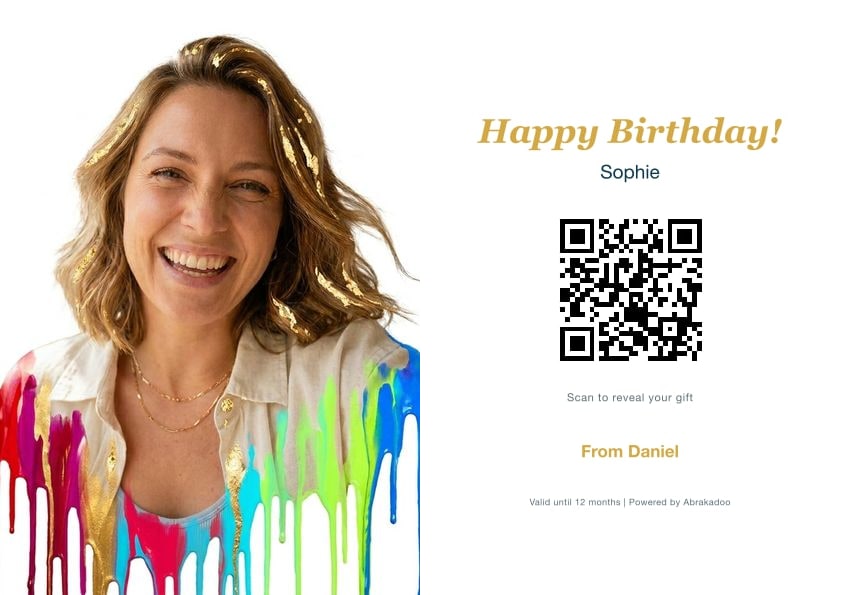
Your photo. Their caricature. One unforgettable reveal.
Upload a photo, pick gift categories, and we build a personal gift page with caricatures, mystery boxes and a printable QR voucher.
Try the live demoWhy presentation changes everything
Here is the part that quietly solves the biggest worry of all: that the number is the only thing the recipient will notice. In practice, it usually is not. How a gift card is given shapes how it feels far more than the balance does. A bare card slid across a table reads as an afterthought regardless of how much money to put on a gift card you agonized over. The same card, presented with a little thought, feels like a real gift.
Think about what actually sticks in memory after a birthday. It is rarely the exact figure on the card. It is the note, the wrapping, the small in-joke, the sense that someone chose this for you specifically. When the presentation carries warmth, a modest amount feels generous, and the number stops being the headline. Pair a sensible figure with a personal moment, and the figure recedes into the background where it belongs.
Spending five extra minutes on how you hand it over changes the entire impression for free. Here are a few ways to make whatever amount you chose feel genuinely thoughtful, whether that is €20 or €200.
- Write something real. Two specific sentences about why you chose this for them beats a generic "Happy Birthday" every time.
- Match the store to the person. A card to a place they already love signals that you pay attention, which is worth more than extra euros.
- Add a tiny pairing. A €30 coffee card with a nice mug turns a small balance into a small story. A bookstore card tucked inside a book you loved, with a handwritten Post-it noting why you think they will love it, does exactly the same thing. A streaming gift card alongside a handwritten watch list of your favorite films is another pairing that costs nothing extra but says a great deal.
- Present it properly. A personal gift page or a small mystery box around the reveal makes the moment feel like a special occasion rather than a handover.
- Round to the occasion. An amount that nods to the event reads as deliberate, not random.
- Watch for inactivity fees. If you are loading a larger amount, check whether the card carries inactivity fees after a certain period. Choosing a card the recipient will use regularly means the full balance actually gets enjoyed.
Do these and the dreaded "they will only see the number" worry simply dissolves. The person sees the thought first. That is what people remember, and it is the one thing no balance, large or small, can buy on its own. If you want more ideas for dressing up the moment, our guide on how to personalize a gift card walks through simple ways to make a standard card feel like it was made for one person. And whenever you are ready to put it all together, abrakadoo.com is a good place to start.
Frequently asked questions
How much money should I put on a gift card?
What is the average gift card amount?
How much money do most people give on a gift card for a birthday?
Is a €25 gift card enough?
How much should I put on a gift card for a wedding gift?

Builds gift experiences in Cyprus together with Konstantina. Believes the best thing you can give is a special moment.